


Kiasha Govender MICOS PECNITI, Honorary Lecturer and Specialist Consultant
Mocza C Dlova MICOS PECNITI PhD Associates, Professor and Chief Specialist¹
¹ Dermatology Department, Nelson R Mandela School of Medicine, University of KwaZulu-Natal, Durban, South Africa
The pathogenesis of acne vulgaris is multifactorial and is almost similar in both light and dark skin phototypes. Treatment modalities are, therefore, similar in all ethnic groups and designed to address multiple aspects of disease pathogenesis simultaneously. Specific aetiological agents, clinical characteristics, and sequelae of the disease differ in darker skin phototypes, and as such, this group of patients needs special attention.
The most critical issue related to acne in patients with dark skin is the development of sequelae-like post-inflammatory hyperpigmentation (PIH) and scarring. Acne hyperpigmented macules are very common in patients with ethnic skin. PIH may develop in response to the acne itself or to aggressive acne treatment. It is important to address PIH at an early stage and manage this concomitantly with the active acne lesions.
Acne vulgaris can have a long-lasting effect on a patient’s self-confidence, self-esteem, and social interactions. It can cause a significant decline in quality of life and has led to clinicians opting towards more aggressive and continued interventions to contain the disease and its lingering effect on physical and emotional wellbeing. A holistic approach to management, centred on individualised therapy, is essential. Therapy must integrate patient characteristics such as age, gender, lifestyle, and comorbid medical conditions.
The high incidence of PIH as a lingering effect of acne in ethnic patients warrants an aggressive, yet careful, approach to therapy. Treatment must be selected to achieve a balance between eliminating acne and inducing PIH. Consequently, risk factors that predispose patients to skin irritation should be closely monitored.
Keloid formation is also more common in people with black, Asian, and Hispanic skin following acne than in Caucasian patients. It is not as common as PIH but can be a more permanent, disfiguring outcome of the disease.
Specific aetiological agents involved in the pathogenesis of acne in patients with ethnic skin include pomades, oils, steroids, and oily cosmetics used on the skin. These factors need to be addressed early on in the course of disease management.
It is believed that acne vulgaris should be treated as a chronic disease, and guidelines recommend treatment in two phases. The induction phase aims to clear the majority of acne, while the maintenance phase involves long-term therapy to prevent recurrence of lesions. For the purposes of this review, we will divide the management into four categories: general measures, topical treatment, systemic medication, and adjuvant therapy.
The initial step when managing acne vulgaris in ethnic skin is eliciting an in-depth medical history of the patient’s skin type and beauty practices, along with skin- and haircare products. This is designed to eliminate any possible aetiological agents, as well as to limit the potential for irritation and subsequent PIH risk.
Oily skincare products, hair and scalp pomades, and bleaching creams containing corticosteroids should be eliminated from the skincare regime, and patients should be counselled extensively against their use.
Photoprotection in the form of daily broad-spectrum sunscreen use should be encouraged, as it aids in the treatment of PIH, as well as protecting from the potential photosensitising side effects of some acne medication. Patients with darker skin may prefer to omit sunscreens from their regime if they believe them to be ineffective and greasy. There is also a lack of a photoprotection culture among this group of patients. A 1992 study measuring sun protection behaviours in African-American individuals found that only 9% of patients were very likely to use sunscreen, while a massive 81% were unlikely to use them at all. Prescription of gel- or lotion-based sunscreen formulas obviates the oily feeling and may be preferred by patients with black skin.
An important concern in treating acne with topical agents in ethnic skins is irritant contact dermatitis (ICD). There is much controversy regarding whether people with ethnic skin have a greater susceptibility to ICD than those with fairer skin. The latest studies demonstrate a higher likelihood of irritant reactions in black and Hispanic patients compared with Caucasians. This irritation has the potential to induce sustained PIH. A careful assessment of patients’ skin characteristics and behaviour is, therefore, necessary prior to commencing any topical treatment. A dry, atopic- or rosacea-prone skin type, or a positive history of irritant reactions to acne therapy or skincare products, suggests a greater likelihood towards irritation. All skin types are drier in winter and in cities or countries with lower humidity. This needs to be taken into account, as irritation is more likely when the skin is dry.
Harsh over-the-counter skin cleansers, alcohol-based toners, make-up removers, harsh soaps, and aggressive skincare practices, such as excessive cleansing and the use of scrubs and brushes on the skin, should be avoided. Tolerability can be improved by commencing treatment with a low concentration of the topical agent and slowly increasing this as the patient becomes accustomed, starting off with alternate day or twice-weekly usage, prescribing cream- and lotion-based formulas as opposed to gels, using the topical acne agent after the application of a soothing moisturiser, and sometimes using oral treatment alone when topical side effects are intolerable.
Topical agents can be used alone to treat mild acne or in combination with oral treatment for the management of moderate-to-severe acne. They are useful both in the induction and maintenance phase of treatment.
Topical retinoids are the favourite choice for first-line therapy, as well as maintenance therapy for mild-to-moderate acne in darker skin. There are vitamin A analogues that have excellent effects against both comedones and inflamed acne lesions. The most commonly used agents worldwide are adapalene, isotretinoin, and tretinoin. They are contraindicated in pregnancy and have the potential to induce photosensitivity and ICD. However, topical retinoids can be used safely and effectively in patients with darker skin using strategies already described. Various studies demonstrate that while ICD is possible with all retinoids, adapalene has the lowest risk of sensitivity. A 2002 study showed that adapalene is more effective and better tolerated in patients with black skin in comparison with those with white. Of particular significance to ethnic patients is the ability of retinoids not only to treat active acne lesions but also PIH. It is able to do this by increasing epidermal turnover leading to melanin dispersion.
Benzoyl peroxide (BPO) is an antimicrobial agent, available over the counter in a variety of preparations including creams, gels, washes, and foams. It has stronger activity against Propionibacterium acnes than other topical agents do. It is also keratolytic and anti-comedogenic. BPO increases the efficacy of oral antibiotics and decreases the development of antibiotic resistance during therapy. Combinations of BPO with adapalene and topical antibiotics are available and show good efficacy. It has an excellent safety profile but may cause local irritation.
Topical antibiotics are usually used in combination therapy for mild acne in patients with ethnic skin or as an adjunct to systemic treatment in moderate-to-severe acne. Erythromycin and clindamycin both inhibit the synthesis of bacterial protein. Topical antibiotics are associated with antibiotic resistance and so they should not be used alone.
This dicarboxylic acid is antimicrobial, keratolytic, and anti-inflammatory. It also has a role in the treatment of PIH as it inhibits tyrosinase. It may be especially suited for patients with ethnic skin, given its low irritant potential.
Sodium sulfacetamide and topical sulfur in various concentrations can also be safely used in the treatment of acne in patients with darker skin.
Systemic treatment should be considered earlier in the treatment of patients with skin of colour, as it has been shown that, on histology, even comedones display inflammatory change. Also, the risk of PIH and scarring is too great in patients with ethnic skin to withhold systemic treatment for too long.
Oral antibiotics are used in the treatment of acne as an antibacterial and anti-inflammatory agent. Treatment decreases the volume of P. acnes in the skin and inhibits the host’s inflammatory response. Its use is indicated in moderate-to-severe inflammatory acne vulgaris, in mild acne where topical treatment has failed, or when treating large areas where topical treatment is not possible. Antibiotic resistance is a serious problem and a danger to public health. Therefore, rational prescription should be employed. It is suggested that antibiotics should be used for a maximum period of three to four months, only during the induction phase, and with topical BPO to decrease the risk of resistance. Oral antibiotics are not advocated as maintenance therapy. Frequently used agents include the tetracyclines and macrolides.
Hormonal factors should be addressed, particularly in hirsute women with irregular menstrual cycles. Anti-androgens in the form of the combined oral contraceptive pill, cyproterone acetate, and spironolactone are effective for decreasing seborrhoea and maintaining remission of acne for long periods of time.
Isotretinoin is an oral retinoid approved for the treatment of severe nodulocystic acne. The efficacy of isotretinoin in African-American patients with recalcitrant nodulocystic acne was the basis of a study by Kelly et al. They found specific effects in patients with black skin, which included early-onset flares in facial areas originally free from acne lesions, improvement in PIH, and a greyish facial hue due to the drying effects of the drug. That being so, adequate patient education and counselling is essential. Other studies have also demonstrated the safety and efficacy of isotretinoin in Middle Eastern, Asian, and Indian subjects. Careful patient selection and monitoring are needed as the drug is associated with multiple side effects, including teratogenicity, dyslipidaemia, hepatotoxicity, benign intracranial hypertension, and severe mood instability.
Adjunctive measures can be employed concurrently in the induction phase of acne treatment to assist with inflammatory and comedonal lesions or in the maintenance phase to help in the management of PIH and scarring.
Chemical peels simultaneously address both acne and PIH. Depending on the depth of the peel, scarring from healed acne lesions may also be targeted. A number of clinical studies have shown the efficacy of chemical peels, specifically in patients with ethnic skin. Patients with Fitzpatrick skin phototypes IV to VI can withstand only superficial or medium-depth chemical peels. It is not uncommon for those with darker skin to develop transient PIH after chemical peeling. Patients’ response to peels may vary, so patient and peel selection should be performed with caution. Cessation of concurrent retinoid treatment a week prior to peel, commencing at low peel concentration, and sun avoidance may help alleviate the risk of side effects.
Glycolic acid peels cause epidermolysis followed by stratum corneum desquamation and epidermal melanin dispersion. Concentrations of 10–70% peels are safe and effective in those with dark skin, showing a bactericidal effect against P. acnes, an anti-inflammatory effect on active acne lesions, and a lightening effect on PIH. Lactic acid peels, Jessner’s solution, and trichloroacetic acid peels have also been tried but are used less frequently due to the risk of side effects, including pigmentation and scarring. Newer peels currently being tested in patients with darker skin include pyruvic acid, beta-lipohydroxy acid, mandelic acid, and amino fruit acid peels.
This involves the mechanical superficial exfoliation of the skin, leading to the removal of comedones as well as treatment of PIH and superficial acne scars. Only a few studies have been conducted on patients with ethnic skin, but these have shown beneficial outcomes in this population.
Inflammatory cysts and nodules cause an increased risk of severe keloidal scarring in those with ethnic skin. Quick resolution of these lesions may be achieved by the injection of intralesional corticosteroids.
Very few studies have evaluated the use of these devices in patients with ethnic skin, but many case reports of its use have been documented in the literature. Some of these are safe to use in pregnancy. Blue light targets porphyrins in P. acnes. The diode laser decreases sebum production and inflammatory lesions in acne and has been evaluated in two clinical studies in Asian patients, showing efficacy in Fitzpatrick skin phototypes III to VI. Further studies on the effectiveness and safety of intense pulsed light in patients with darker skin are needed, as previous work has shown contradictory results. Photodynamic therapy (PDT) has been successfully used in Asian and African-American patients but may cause scaling and transient hyperpigmentation. Photopneumatic therapy is a newer treatment option that has been shown to be safe and effective in the management of acne.
Hydroquinone, in a 2–4% concentration, is often required to address PIH in patients with ethnic skin and has been greatly effective. Side effects, including cosmetic ochronosis, ICD, photosensitivity, and perilesional hypopigmentation limit its use. Other agents that can be used to target PIH include kojic acid, mulberry extract, niacinamide, or stable forms of resorcinol and arbutin.
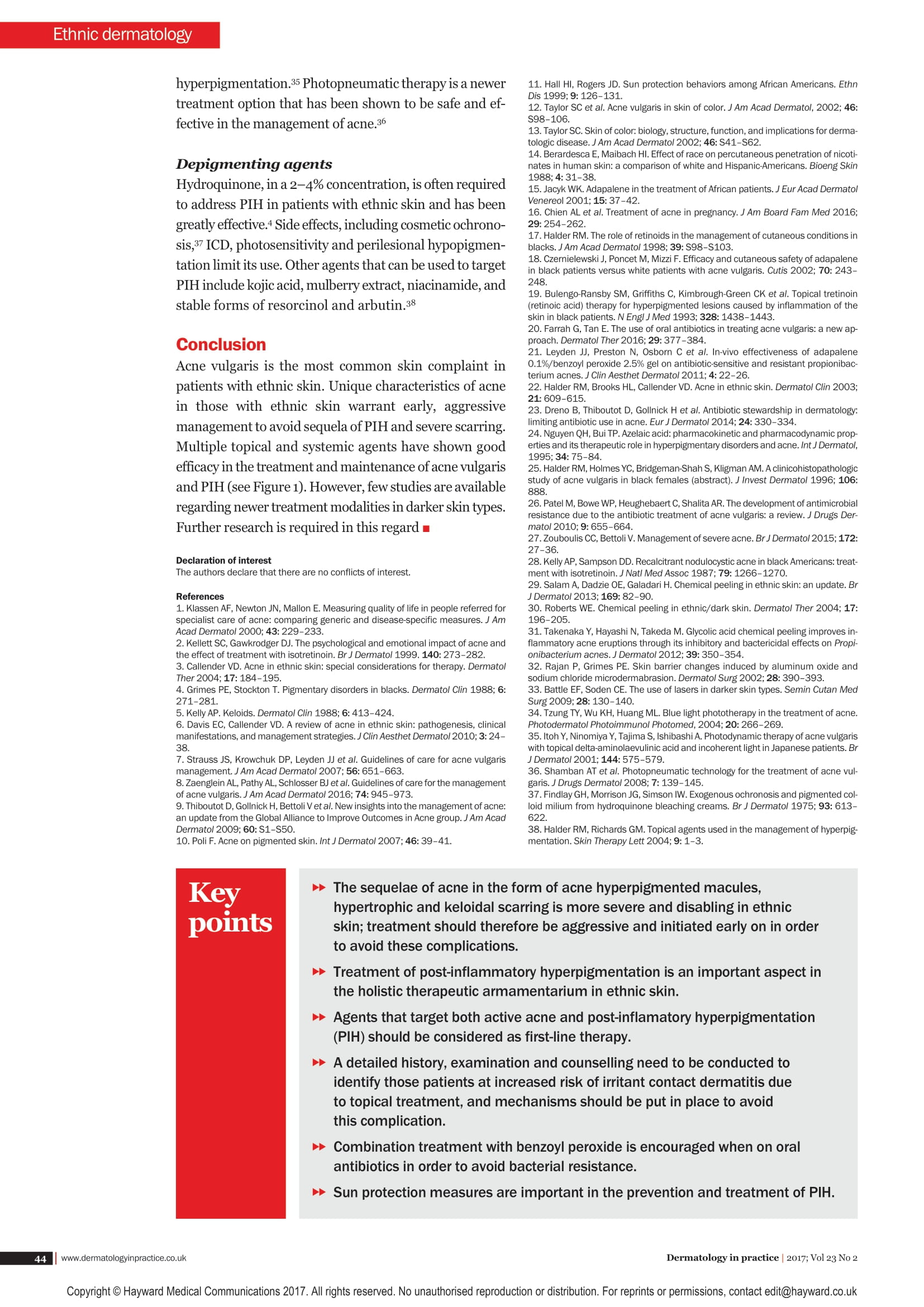
Acne vulgaris is the most common skin complaint in patients with ethnic skin. Unique characteristics of acne in those with ethnic skin warrant early, aggressive management to avoid sequelae of PIH and severe scarring. Multiple topical and systemic agents have shown good efficacy in the treatment and maintenance of acne vulgaris and PIH. However, few studies are available regarding newer treatment modalities in darker skin types. Further research is required in this regard.
The authors declare that there are no conflicts of interest.
The pathogenesis of acne vulgaris is multifactorial and is almost similar in both light and dark skin phototypes. Treatment modalities are, therefore, similar in all ethnic groups and designed to address multiple aspects of disease pathogenesis simultaneously. Specific aetiological agents, clinical characteristics and sequelae of the disease differ in darker skin phototypes, and as such, this group of patients needs special attention.